
A construction project can have a detailed cost plan, an agreed budget and an established delivery team, yet still lack a reliable understanding of when the works will actually be completed.
This becomes particularly challenging when construction is already underway.
An inaccurate or outdated programme does more than create uncertainty around completion dates. It can affect subcontractor coordination, procurement priorities, resource allocation, site preliminaries and the ability to make informed commercial decisions.
Cost, programme and procurement are not separate exercises. Each influences the others.
When the Programme No Longer Reflects the Project
On a major residential lifestyle development in South East Queensland, STRATIVM was engaged to provide construction programming support for two substantial community facilities already well into construction.
Works had been underway for more than eight months, yet the project team did not have a sufficiently accurate, up-to-date programme reflecting actual progress and forecasting the remaining works.
The two buildings were at significantly different stages. One was approaching an enclosed shell, with internal services rough-in underway, while the other remained at an earlier structural and framing stage.
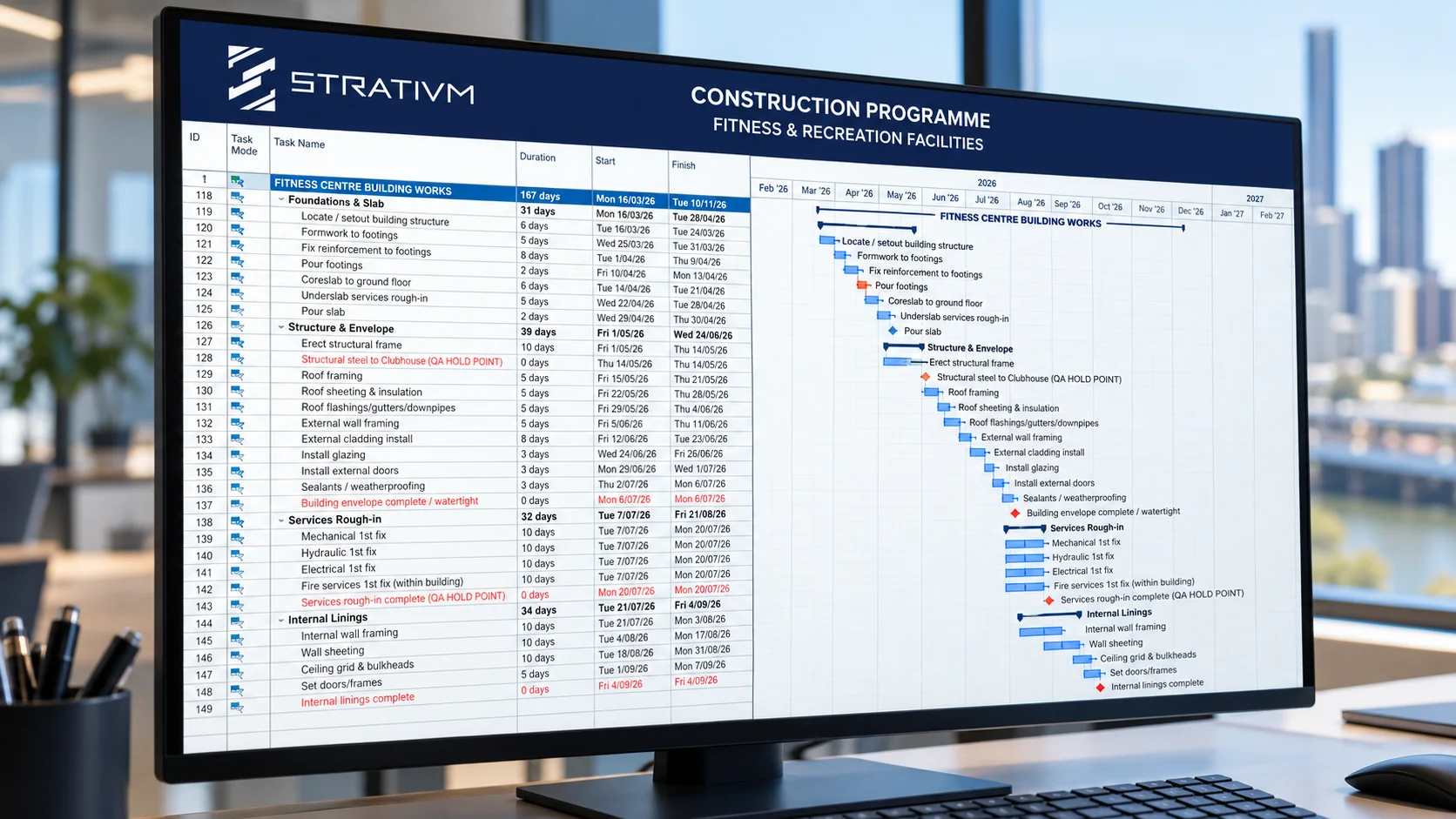
STRATIVM assessed the construction status, remaining activities, sequencing and dependencies to develop realistic programmes for the outstanding works.
The exercise established forecast practical completion dates. More importantly, it identified the critical path: the sequence of activities governing completion.
This gave the project team a clearer understanding of which activities required particular attention, how delays to critical work could affect completion and where procurement, subcontractor coordination and construction sequencing needed to align.
The value was not simply producing an updated programme. It was providing a more reliable basis for managing the remaining works and making informed delivery decisions.
“A construction programme should do more than forecast completion. It should identify what drives completion.”
Why the Critical Path Matters Commercially
A programme should do more than show when activities are scheduled to start and finish. It should explain how the project is intended to be delivered and which activities are driving completion.
Understanding the critical path helps a project team focus on the work that matters most to the overall completion date.
For example, a delayed procurement item may affect a critical installation activity. That delay can then influence follow-on trades, commissioning and ultimately practical completion.
Similarly, an unrealistic construction sequence may create trade congestion, inefficient resource allocation or extended site preliminaries.
These are not simply programming issues. They can have direct commercial consequences.
By understanding the relationship between construction activities, procurement requirements and programme dependencies, project teams are better positioned to evaluate risks, prioritise decisions and consider practical alternatives.
Connecting the Programme to the Commercial Strategy
A credible construction programme should be developed with an understanding of how the project will actually be built.
That includes consideration of construction methodology, site constraints, trade sequencing, procurement lead times, resource requirements, commissioning and handover.
These factors should also inform the project’s commercial planning.
A shorter programme is not automatically a more economical programme. Accelerating works may require additional labour, extended working hours or more complex trade coordination. Conversely, an unnecessarily prolonged programme can increase time-related costs and delay completion.
The objective is not simply to produce the shortest possible construction period. It is to establish a realistic, coordinated and commercially informed delivery strategy.
This is particularly important when projects are already underway and the programme needs to be reconciled with actual site progress rather than assumptions made months earlier.
Better Programmes. Better Project Decisions.
Construction programming is sometimes treated as an administrative requirement or a document prepared to satisfy a contractual obligation.
In practice, a properly developed and maintained programme is an important management tool.
It provides visibility of the remaining works, identifies critical dependencies and supports more informed decisions about procurement, resources, sequencing and delivery risk.
At STRATIVM, our approach draws on practical contractor-side experience and an understanding of how construction methodology, cost and programme interact.
Because knowing when a project is forecast to finish is important.
Understanding what drives that completion date is where better project decisions begin.