
One of the most frustrating outcomes in construction is taking a project through design and tender, only to discover that market pricing significantly exceeds the available budget.
By that stage, considerable time and professional fees may already have been invested. The options can involve substantial redesign, lengthy value-management exercises or, in some cases, abandoning the project altogether.
The problem is not always that construction costs have unexpectedly increased. Sometimes, it is that commercial certainty has not developed alongside the design.
Establishing Viability Before Committing Further
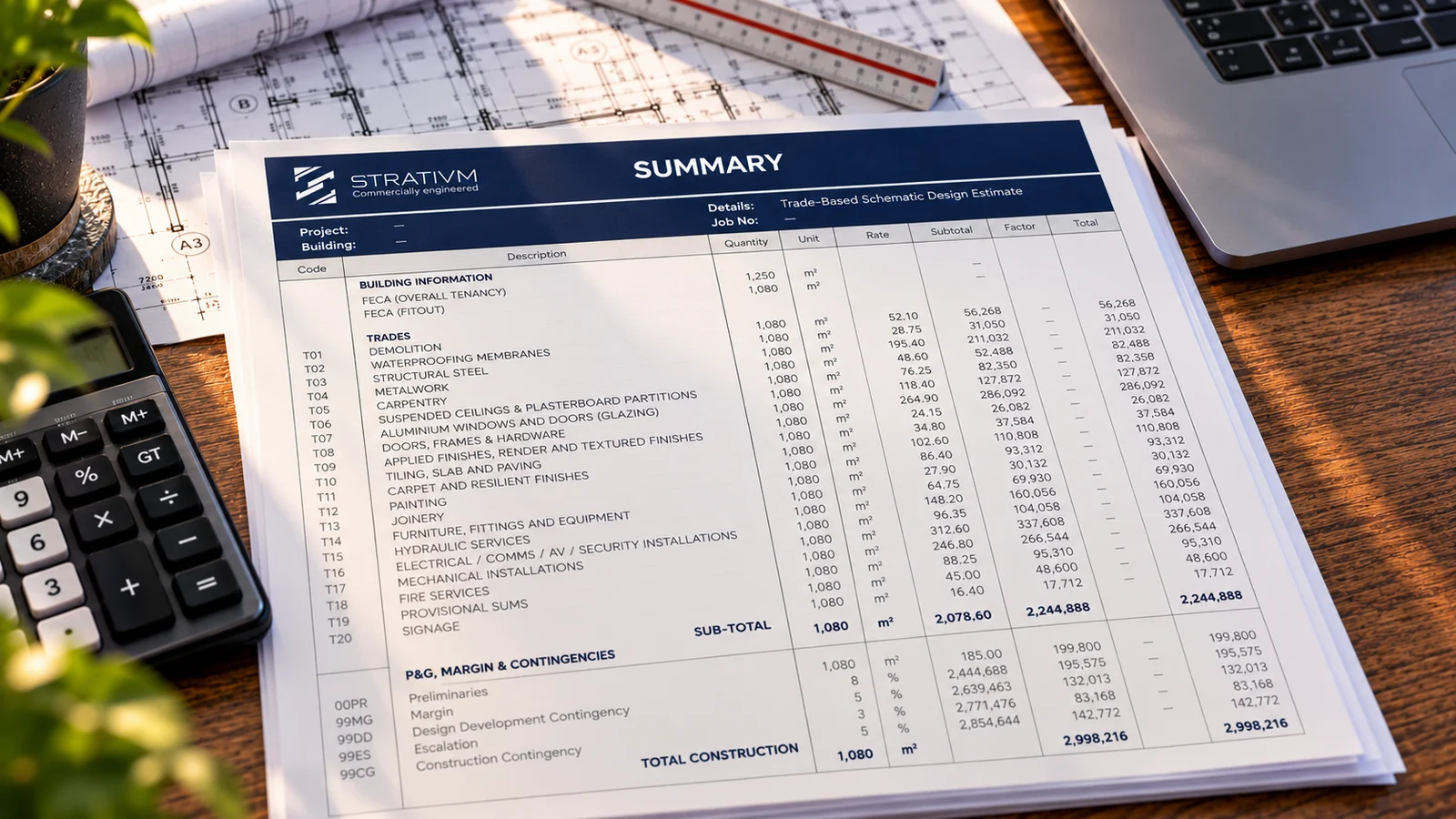
This was the underlying concern raised by a client who engaged STRATIVM to prepare an early-stage feasibility cost plan for a proposed commercial office fit-out.
Having experienced projects reaching tender only for construction pricing to exceed expectations, the client wanted a more informed approach before committing significant resources to the next stage.
Rather than commissioning a fully developed design package, the client initially engaged a limited number of consultants to prepare schematic documentation and undertook preliminary discussions with a building certifier.
STRATIVM was engaged to assess the likely construction costs and establish whether the proposed fit-out was financially viable within the client’s forecast expenditure allowance.
Using the available design information, STRATIVM prepared a trade-based feasibility cost plan, identifying measurable work, provisional allowances, scope assumptions and areas requiring further clarification.
Particular attention was given to elements capable of materially influencing the budget, including building services, existing conditions, specialist finishes, joinery and client-supplied equipment.
The assessment provided a structured commercial basis for understanding the proposed scope, potential cost exposures and appropriate contingencies before seeking management approval.
A Cost Plan Should Inform Decisions, Not Just Report a Number
A meaningful feasibility assessment does more than provide an estimated construction cost.
It should help decision-makers understand:
- Which elements are driving the construction budget.
- What assumptions and allowances underpin the estimate.
- Where further design development or market input is required.
- Which specifications or scope decisions offer opportunities for value management.
- What contingencies may be appropriate given the maturity of the design.
- What should be resolved before progressing to tender.
Importantly, value management should not be confused with simply removing cost. A lower-cost alternative may introduce consequences for programme, quality, functionality or long-term performance.
The objective is to identify commercially sensible options while protecting the project’s underlying purpose.
The Outcome: Confidence to Progress
STRATIVM’s initial feasibility cost plan indicated that the proposed fit-out was achievable within the client’s forecast expenditure allowance, based on the available design information and documented assumptions.
The assessment provided the client with a clearer understanding of the anticipated construction expenditure, the scope included, outstanding design considerations and areas where appropriate contingencies may be required.
Importantly, it established a commercially informed basis for presenting the proposal to management and considering the next stage of investment.
With the initial feasibility assessment aligning with the client’s expenditure expectations, the project is progressing beyond the preliminary feasibility stage.
While the final construction cost remains subject to design development, market pricing and delivery conditions, the client was able to progress with greater confidence in the project’s financial viability.
“Commercial clarity should come before major commitments, not after them.”
Better Information. Better Decisions.
Early commercial input cannot eliminate every uncertainty or guarantee a particular tender outcome.
What it can do is help clients identify potential budget pressures while there is still an opportunity to respond constructively.
That may mean refining the brief, reconsidering specifications, adjusting scope, allowing appropriate contingencies or confirming that the project is sufficiently viable to proceed.
At STRATIVM, we believe commercial clarity should inform major commitments, rather than being considered only after them.
Because the earlier a project understands its commercial position, the more options its decision-makers have.